July 26, 2026 - Nearshoring to Turkey in 2026: The Facts, Figures and ROI Behind Europe's Rising Tech Hub
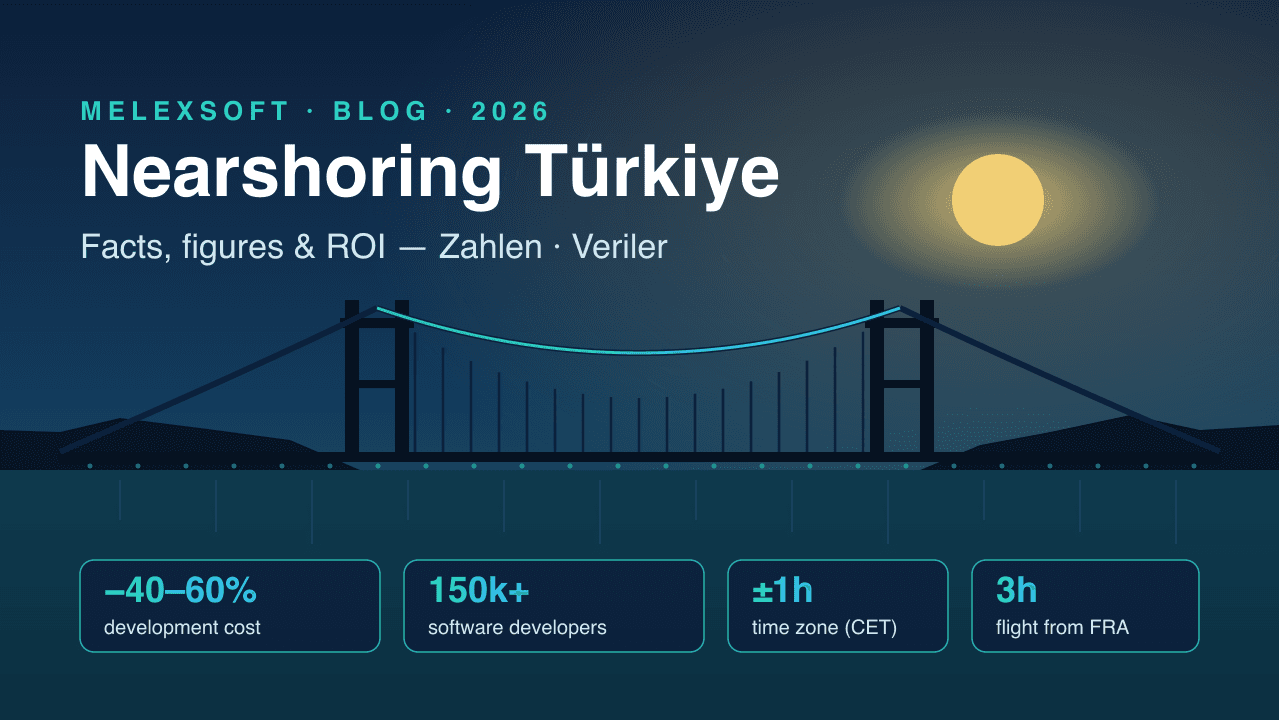
A 33-million-strong workforce, 40–60% lower development costs, a one-hour time difference and an AI-driven productivity boom: a data-driven look at why Turkey has become Europe's most compelling nearshoring destination.

Melexsoft Team
Editorial
When European executives talked about nearshoring five years ago, the question was whether to move development work closer to home. In 2026, the question is only where. And increasingly, the data points to the same answer: Turkey.
What began as a supply chain correction after the pandemic has matured into a structural shift. Procurement associations, staffing firms and software buyers across the DACH region now treat Turkey not as an exotic alternative but as a first-choice location for building development capacity. In this article we look past the buzzwords and into the numbers: how big is Turkey's tech talent pool really, what does a nearshore team actually cost, which risks show up in the statistics — and how AI is changing the entire equation in 2026.
1. The Macro Trend: Nearshoring Has Moved From Option to Strategy
The German procurement association BME (Bundesverband Materialwirtschaft, Einkauf und Logistik) has been unusually direct about it: nearshoring in Turkey "offers enormous potential" for European companies rethinking their supply chains. The industrial numbers back that up. Turkey is Europe's largest steel producer, exporting 4.5 million tons to the EU in 2023 alone. It is Europe's second-largest plastics producer, with 1.84 million tons of exports worth 5.43 billion dollars in 2023, and Europe's second-largest metal casting industry, producing 3.1 million tons with revenues of 8.5 billion euros.
Why do manufacturing statistics matter for a software decision? Because they prove the underlying thesis: European companies systematically relocate work to Turkey when proximity, cost and quality all have to hold at the same time. Software is simply the next industry following a path that procurement teams have already validated at scale. The same advantages BME cites for physical goods — shorter delivery times, lower transport costs, greater flexibility — translate directly into software terms: shorter feedback loops, overlapping working hours and travel costs that fit inside a normal project budget.
2. The Talent Pool: 33 Million Workers, a Six-Figure Developer Population
Turkey's labor market is vast. FMC Group, one of the longest-established German-Turkish nearshoring consultancies, puts the workforce at roughly 33 million people — more than the entire population of Scandinavia. Within that pool sits one of the youngest tech workforces in Europe: the median age in Turkey is around 34, compared to roughly 45 in Germany.
The software slice of that workforce has grown just as fast. Industry estimates put Turkey's developer population at well over 150,000 professionals, and the country's universities add tens of thousands of new engineering and IT graduates every single year. The infrastructure has kept pace: more than 100 official Technology Development Zones ("Teknokent") now host thousands of technology companies, clustered around Istanbul, Ankara and Izmir. Istanbul alone has quietly become one of the largest developer cities on the continent.
Language is the underrated statistic. English is standard in Turkish tech education, and thanks to the roughly three million people of Turkish origin living in Germany, there is a steady stream of bilingual, German-speaking professionals returning to Istanbul and Ankara — engineers who understand both a Lastenheft and a sprint review. FMC Group explicitly highlights the high availability of English- and German-speaking employees as one of Turkey's defining advantages.
3. What It Actually Costs: A Realistic Calculation
Let's talk concrete numbers. An experienced senior developer in Germany costs between 90 and 130 euros per hour. For comparable seniority and quality, Turkish nearshore rates come in 40 to 60 percent lower — without the hidden costs that make classic offshoring expensive, such as time zone losses and excessive coordination overhead.
Scaled up, the effect is dramatic. Take a typical product team: three developers, six months, roughly 2,880 development hours. At a blended German rate of 110 euros per hour, that team costs around 316,800 euros. The same team delivered from Istanbul at a blended 55 euros per hour costs around 158,400 euros — a saving of more than 150,000 euros on a single mid-sized project. Even a modest 500-hour engagement typically saves 20,000 euros or more.
There is a second, less obvious saving: you do not need to found a local company. Established models like employer-of-record and build-operate-transfer mean a German Mittelstand company can have a dedicated Turkish team on its books within weeks, with no legal entity, no local payroll administration and no long-term lock-in. Compare that with the 25–30 percent of annual salary that German recruiters charge per hire, plus six months of average time-to-fill for senior roles, and the business case usually writes itself.
4. Geography Is a Feature: Time Zones, Flights and Culture
The economics only work if collaboration works — and this is where Turkey quantifiably beats far-shore destinations. Turkey is on UTC+3: just one hour ahead of Germany in summer and two in winter. That means six to seven fully overlapping working hours every single day. Your daily standup happens live, not via recorded video. Compare that with India (up to four and a half hours ahead) or the US West Coast (nine hours behind), where every question waits overnight.
Physical proximity is just as measurable. Istanbul is a three-hour direct flight from Frankfurt, Munich or Berlin, with multiple daily connections from virtually every major German airport. A kickoff workshop in Istanbul is a one-day trip, not a week-long expedition. FMC Group lists exactly this — employees who can travel to headquarters at short notice for meetings and training — among the top reasons its clients choose Turkey.
Culture closes the loop. Decades of intensive German-Turkish economic ties, a bilateral trade volume of around 50 billion euros a year and a business culture shaped by European standards mean that project management, documentation discipline and quality expectations feel familiar from day one.
5. The Risks the Data Shows — and How to Neutralize Them
An honest, data-driven article has to name the risks, because they are real and they are measurable. The BME points to two: persistent inflation and currency volatility. The Turkish lira has lost more than 70 percent of its value against the US dollar in recent years. For buyers this cuts both ways — it deepens the cost advantage, but it destabilizes any contract written in lira.
The mitigation is standard practice by now. Professional nearshoring engagements are denominated in euros or dollars, with clearly defined rates and, where needed, indexation clauses. Working through an established partner or employer-of-record shifts the entire currency, payroll and compliance burden away from your team.
On the legal side, the framework is stronger than most first-time buyers expect. Turkey has been in a customs union with the EU since 1996. Its data protection law, the KVKK, is closely modeled on European standards, and IP assignment and confidentiality agreements are enforceable under Turkish law — while cross-border contracts can just as easily be governed by German law with European arbitration. None of this is exotic; it is the same playbook German industry has used in Turkey for decades.
6. The AI Multiplier: Why 2026 Changes the Equation Again
Here is the part most nearshoring comparisons still miss. The cost debate of the last decade — 90 euros an hour versus 55 — is being overtaken by a productivity debate. AI-assisted engineering has fundamentally changed what one senior developer can deliver: with agentic coding tools, a single experienced architect now orchestrates work that used to occupy a whole team.
This multiplies the nearshoring math instead of replacing it. A Turkish senior engineer at 40–60 percent lower cost, working AI-first, does not just save you money on the same output — they deliver two to three times the output for that lower price. The relevant metric is no longer the hourly rate but cost per shipped feature, and on that metric the gap between a traditional German team and an AI-native nearshore team is no longer a percentage. It is a multiple.
This is exactly where the Turkish tech scene has an edge that rarely shows up in official statistics: a young developer population adopts new tooling fast. Teams in Istanbul were building with LLM-based agents while much of the European enterprise world was still writing AI policy documents.
7. Conclusion: What the Numbers Mean for Your Roadmap
Summarized in one paragraph: Turkey offers a 33-million-person workforce with a six-figure developer pool, cost savings of 40–60 percent that compound into six-figure amounts on ordinary projects, a one-to-two-hour time difference with three-hour flights, a legal framework anchored by an EU customs union and GDPR-style data protection — and manageable, well-understood currency risks that professional contract structures neutralize.
The practical path in is smaller than most companies think. Start with a pilot: one clearly scoped project or a two-to-three-person dedicated team, contracted in euros, measured not on hourly rates but on cycle time and shipped outcomes. If the pilot confirms the numbers above — and in our experience it does — scale the team. That is the quiet lesson in all this data: the companies winning with nearshoring in 2026 did not make one big decision. They made one small, measurable one, and let the numbers do the convincing.
Nearshoring at Melexsoft: a delivery method, not a product
Everything described here is how we deliver — not what we sell. What clients buy from Melexsoft is an outcome: a growth system that measurably drives revenue, built by our Istanbul engineering team and steered by German-speaking management. How that works in practice, what it costs, and why the location is a structural advantage: Nearshoring Istanbul at Melexsoft.